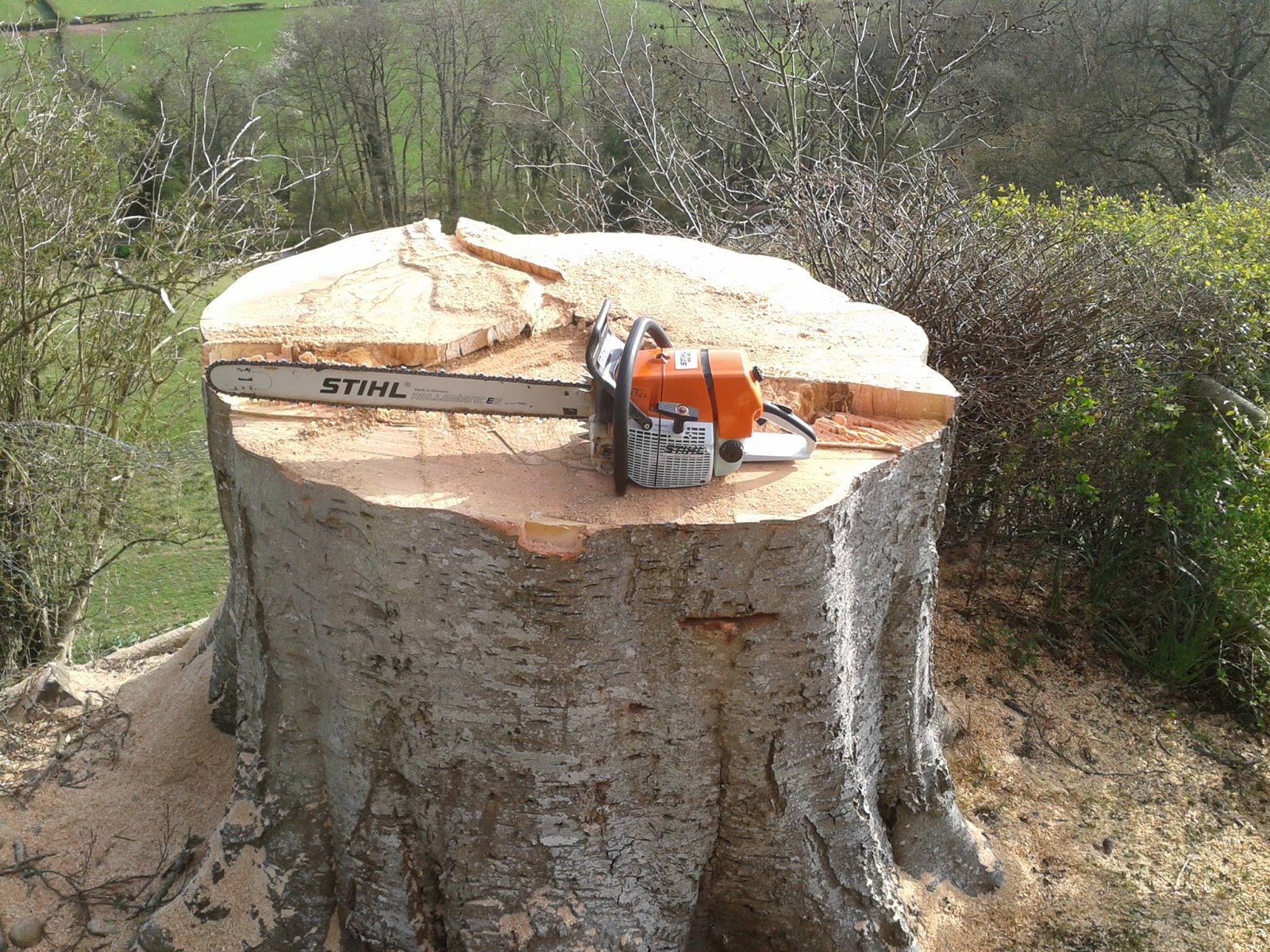
End of last summer I was asked by my mate, Rob Penn, to dismantle an Ash at Llanvihangel Court. Lovely woodland there. The purpose was to make a film for Radio 4 to smash up on the BBC News 24 site (or something like that!); a promo option for his lovely book, The Man Who Made Things Out Of Trees. A story of how vital and integral the Ash is to humanity, only one tree in so many.
Rob is good at seeking out nice trees, and the one at Llanvihangel was early mature, a slight lean and not a lot of taper up to the crown. I reckon we laid a sixty foot stick down, and the other company there that day, Martin Fraser, with his Wood Mizer milled the cord there and then, and Bart Bagnell made some spoons and spatulas, and fashioned a sweet little Oak wedge for my grandfather's hatchet and brought that tool back to life.
I had been thinking about what it is to harvest trees, to cut by hand, and the connection I make with every tree I take. I wrote this little rhyme.
Making the bond
The cut that breaks the ring
that would have bound the year
takes a soul from air,
a prayer from earth
yellow and redden down of cool green flames
that curled out of the gold of their first change.
Something
like a sting
comes
with the work.
A balancing.
https://www.youtube.com/watch?v=ojwtW1raMlM
Saturday, 9 April 2016

Friday, 26 February 2016
Poetry Workshop mission in The Jungle.
Drawing together a crazy oscillation of feelings after visiting a refugee camp and creating a rational, cognitive response, I think, is something I am always going to struggle to achieve.
The first thing me and my two companions saw driving into The Jungle, was a tall and very beautiful black woman, mid-twenties, with a load of swagger. She was attracting the lewd attention of every man who passed her and the sexual charge was the last thing I was expecting. I have no idea what her gig was, but I assumed she was a refugee. My companions had been asked, well, told by female volunteers at the warehouse, to dress in nothing that would encourage the male refugees to make advances, and they moved around the camp easily enough. This first perspective, the behaviour of those men, was for me, a massive negative.
Leading a poetry workshop in the Theatre was manic. My fellow writers were early to mid-twenties, male, mostly Afghan, and were all over me straight away, touching my hair, hugging me, laughing. The theme of the workshop was 'journey', but they mostly wanted to write about love, the sky, and a better life, which I expected.
One participant, who I could tell was going to be really good, did one in the first five minutes and came back towards the end of the session with a lovely clutch of poems he had gathered from other people in the camp. This one stood out as a tight little haiku:
Four men on four chairs
Talk through life with lofty airs.
Four chairs left empty.
In just over an hour a lot of life experience and aspiration was laid down and then it all stopped. The lads gave me back all the pens and paper I had provided, grabbed a hacky-sacky and went into this really energetic game of mass piggy-in-the-middle! job done!
Moving about the camp is probably the most harrowing and evoking experience of my life. The main drags are stoned, and there is a basic level of sanitation; plumbed in water at set points, portaloos that hum of decomposing shit, and the reek of piss that has ensconced itself the latent smell of the earth. Shops, of the stores variety, and the coffee, all of them shanty. The school was awesome, the bookshop, the youth centre. The Ethiopian church with its gable-end mounted cross gave the sky line an unforgettable composure. Everything shanty, everything low, in a low, level expanse of industrial wasteland with a high fence against the highway, and banked up earth ringing the rest of the perimeter. Virtually out of eye sight. Activity everywhere, and a strange, gnawing sense of boredom and frustration, and exhaustion, dragging through your body as you walk through the madness of abandoned tents, or not, ripped open, clothes strewn about, food scat over the ground, faeces here and there, and the utter disillusion of traumatised people coming down on you like a sleep you really need to take.
People want solutions, or just a solution. I think it is ludicrous to expect that there can be a solution to a situation that is worsening. I believe individual European societies have to view themselves as a singular entity, as does the European Union as a whole. Society in terms of oneness, society as an individual with emotions and a psychology that can be affected by action. I believe how we treat refugees now will affect how we behave as a society in the future. How we respond to hardship or threat, or the opportunity of prospect or good. I believe that if we do not consider human beings to be composed of potential, to inherently veer towards kindness, and that we treat people appropriate to these factors, we are likely to damage ourselves.
The first thing me and my two companions saw driving into The Jungle, was a tall and very beautiful black woman, mid-twenties, with a load of swagger. She was attracting the lewd attention of every man who passed her and the sexual charge was the last thing I was expecting. I have no idea what her gig was, but I assumed she was a refugee. My companions had been asked, well, told by female volunteers at the warehouse, to dress in nothing that would encourage the male refugees to make advances, and they moved around the camp easily enough. This first perspective, the behaviour of those men, was for me, a massive negative.
Leading a poetry workshop in the Theatre was manic. My fellow writers were early to mid-twenties, male, mostly Afghan, and were all over me straight away, touching my hair, hugging me, laughing. The theme of the workshop was 'journey', but they mostly wanted to write about love, the sky, and a better life, which I expected.
One participant, who I could tell was going to be really good, did one in the first five minutes and came back towards the end of the session with a lovely clutch of poems he had gathered from other people in the camp. This one stood out as a tight little haiku:
Four men on four chairs
Talk through life with lofty airs.
Four chairs left empty.
In just over an hour a lot of life experience and aspiration was laid down and then it all stopped. The lads gave me back all the pens and paper I had provided, grabbed a hacky-sacky and went into this really energetic game of mass piggy-in-the-middle! job done!
Moving about the camp is probably the most harrowing and evoking experience of my life. The main drags are stoned, and there is a basic level of sanitation; plumbed in water at set points, portaloos that hum of decomposing shit, and the reek of piss that has ensconced itself the latent smell of the earth. Shops, of the stores variety, and the coffee, all of them shanty. The school was awesome, the bookshop, the youth centre. The Ethiopian church with its gable-end mounted cross gave the sky line an unforgettable composure. Everything shanty, everything low, in a low, level expanse of industrial wasteland with a high fence against the highway, and banked up earth ringing the rest of the perimeter. Virtually out of eye sight. Activity everywhere, and a strange, gnawing sense of boredom and frustration, and exhaustion, dragging through your body as you walk through the madness of abandoned tents, or not, ripped open, clothes strewn about, food scat over the ground, faeces here and there, and the utter disillusion of traumatised people coming down on you like a sleep you really need to take.
People want solutions, or just a solution. I think it is ludicrous to expect that there can be a solution to a situation that is worsening. I believe individual European societies have to view themselves as a singular entity, as does the European Union as a whole. Society in terms of oneness, society as an individual with emotions and a psychology that can be affected by action. I believe how we treat refugees now will affect how we behave as a society in the future. How we respond to hardship or threat, or the opportunity of prospect or good. I believe that if we do not consider human beings to be composed of potential, to inherently veer towards kindness, and that we treat people appropriate to these factors, we are likely to damage ourselves.
Tuesday, 2 February 2016
Calais and ripples of The Jungle
My experience in Calais over the weekend was intense. I did not expect the miles and miles of opressive fencing around the tunnel and ferry port, and The Jungle itself. The visual affect is disturbing and feels unnatural, only you do not instantly recognise it as being unnatural.
The mood in the town is distrustful, raw and wounded. I have never before felt such an urgent need to covet my identity and purpose for being in a European country. Chatting with locals in a volunteer-friendly bar on Saturday night, I suddenly realised that one conversation with the wrong person, and the consequences might have had the potential to be harrowing. The police are not going to respond to a situation involving volunteers until it has gone too far, if they do at all.
Those French who are friendly to the volunteers want to talk, want to debate, they want a resolution. They want no borders. They are impassioned and sincere, inspiring and brave.
The atmosphere in the workshop and warehouse was positive, hopeful and exhausted. The emotional charge of people coming back from The Jungle and trying to get their head around the situation laces everything. The Jungle laces everything, it is all anybody there works for and thinks of. Thinking about being human.
After we wound things down in the workshop I went into the warehouse and a man about my age, very animated, very knowledgeable on the migration that is occuring, was describing how one refugee he spoke to mentioned seeing crocodiles in every country he passed through. The animation was captivating and he kept saying, "...but there are no crocodiles in any of the countries he crossed. There are no crocodiles in the countries he crossed".
The mood in the town is distrustful, raw and wounded. I have never before felt such an urgent need to covet my identity and purpose for being in a European country. Chatting with locals in a volunteer-friendly bar on Saturday night, I suddenly realised that one conversation with the wrong person, and the consequences might have had the potential to be harrowing. The police are not going to respond to a situation involving volunteers until it has gone too far, if they do at all.
Those French who are friendly to the volunteers want to talk, want to debate, they want a resolution. They want no borders. They are impassioned and sincere, inspiring and brave.
The atmosphere in the workshop and warehouse was positive, hopeful and exhausted. The emotional charge of people coming back from The Jungle and trying to get their head around the situation laces everything. The Jungle laces everything, it is all anybody there works for and thinks of. Thinking about being human.
After we wound things down in the workshop I went into the warehouse and a man about my age, very animated, very knowledgeable on the migration that is occuring, was describing how one refugee he spoke to mentioned seeing crocodiles in every country he passed through. The animation was captivating and he kept saying, "...but there are no crocodiles in any of the countries he crossed. There are no crocodiles in the countries he crossed".
Driving by Maidstone in the morning I realised the refugee must have been using the crocodile as a metaphor; a creature that can lie unseen in water and ambush its prey. The 'crocodiles' must be a type of person related to the water in the experiences of those migrating. The dark revelations keep coming and they floor you.
I was not brave enough this time round to venture into The Jungle, I felt I had not earned the right and that really, I had to go there with a purpose. I was happy enough building a floor for a shelter and imagining who might sleep on it and if they would try to imagine me smashing it all together for them!
A superb human being helped me finish my floor off. She told me she just goes into The Jungle to chill and chat with the people. I recognised in her someone with a handle on her emotions and a very real grasp on what is happening; someone to guide, someone to follow. I will never forget her name, and I really hope she is there this week end. So many amazing people. Amazing humans.
I took twenty four hours to reflect on my brief experience, then I booked my ticket for the tunnel this Friday. I am running a poetry workshop in the Jungle on Saturday at 2pm. The theme is journey.
After the intensity I regret I have taken so long to get over there and see for myself, think and feel for myself.
So far this is the only poetry:
Compassion is a bearing, a course to steer,
every degree a shearing away from fear.
I was not brave enough this time round to venture into The Jungle, I felt I had not earned the right and that really, I had to go there with a purpose. I was happy enough building a floor for a shelter and imagining who might sleep on it and if they would try to imagine me smashing it all together for them!
A superb human being helped me finish my floor off. She told me she just goes into The Jungle to chill and chat with the people. I recognised in her someone with a handle on her emotions and a very real grasp on what is happening; someone to guide, someone to follow. I will never forget her name, and I really hope she is there this week end. So many amazing people. Amazing humans.
I took twenty four hours to reflect on my brief experience, then I booked my ticket for the tunnel this Friday. I am running a poetry workshop in the Jungle on Saturday at 2pm. The theme is journey.
After the intensity I regret I have taken so long to get over there and see for myself, think and feel for myself.
So far this is the only poetry:
Compassion is a bearing, a course to steer,
every degree a shearing away from fear.
Wednesday, 6 January 2016
Yggdrasil
A few years ago I started to really obsess about ash trees. They are freakishly human, and although there are similarities between all organisms on this gorgeous planet, trees are not so immediately obvious. You really have to make time to get to know trees, daft as it sounds, this is the way of it.
Ash is the kindest of all trees to humans. All the products that can be fashioned from ash to furnish us with comfort from utensils to eat from and with, to providing the means of building shelter; as part of a system, and so many other uses, elevate us from what would otherwise be a pestilent state of thuggery, rape, and burning!
More, much more, you can cut ash down and burn it immediately (good burning!). I am adamant ash has saved countless human lives by this one, vital property alone. This kindness, that is a human kindness, I believe we learned from this species of tree, so I struggle with the distinction between human and tree!
Hearing about Chalara Fraxinea, or ash die-back, those few years ago (we now have Emerald Ash Borer beetle on the way) set me into a bit of an emotional tizz! I wrote this hysterical poem, 'Yggdrasil', based on the Norse myth. Yggdrasil, is the Norse tree of life that connects heaven with earth. Three roots lead to worlds beneath the surface of the earth. The world ends when Yggdrasil burns. All good stuff. Tolkien particularly thought so!
I learnt an important lesson from my emotional tizz, and that is, you have to write emotion out of poems, otherwise, quite literally, they become an emotional...mess! funny old game the old poetry!
All around the same time I met my good mate, Rob Penn, in our local! Rob was about to start writing a book that ended up being called 'The Man Who Made Things Out Of Trees'. We talked about Yggdrasil and the durability of myth and how inspiring a tree the ash is. It was love! everywhich way!
Rob's book is all about one ash tree, the callow hill ash, me and my best mate, Oli, dismantled and felled for him, and Rob's subsequent journey turning his tree into as many life enhancing products as possible. A great and essential story.
Rob mentioned me and Oli, and my poem in his book, which I have to say was very exciting, but also alarming! so off I went and started writing all the emotion out of the first draft!
Yggdrasil
Drive of colour in the stem is human.
After the saw rips the dust out creamy
a blush-pink at cut arrives discreetly;
the pump of guilt, the physical sermon
filling the open space of reflection.
I am never too sure the work will pay
in term of posterity, not money.
Cutting through the myth into the omen,
along the grain old connections travel
sealing the mouth with the meek tact of leaves:
the silent language we learn with our eyes.
Too much stripping life down to survival.
Further than the horizon of our needs
the flesh-plush of trees in commuting skies.

Ash is the kindest of all trees to humans. All the products that can be fashioned from ash to furnish us with comfort from utensils to eat from and with, to providing the means of building shelter; as part of a system, and so many other uses, elevate us from what would otherwise be a pestilent state of thuggery, rape, and burning!
More, much more, you can cut ash down and burn it immediately (good burning!). I am adamant ash has saved countless human lives by this one, vital property alone. This kindness, that is a human kindness, I believe we learned from this species of tree, so I struggle with the distinction between human and tree!
Hearing about Chalara Fraxinea, or ash die-back, those few years ago (we now have Emerald Ash Borer beetle on the way) set me into a bit of an emotional tizz! I wrote this hysterical poem, 'Yggdrasil', based on the Norse myth. Yggdrasil, is the Norse tree of life that connects heaven with earth. Three roots lead to worlds beneath the surface of the earth. The world ends when Yggdrasil burns. All good stuff. Tolkien particularly thought so!
I learnt an important lesson from my emotional tizz, and that is, you have to write emotion out of poems, otherwise, quite literally, they become an emotional...mess! funny old game the old poetry!
All around the same time I met my good mate, Rob Penn, in our local! Rob was about to start writing a book that ended up being called 'The Man Who Made Things Out Of Trees'. We talked about Yggdrasil and the durability of myth and how inspiring a tree the ash is. It was love! everywhich way!
Rob's book is all about one ash tree, the callow hill ash, me and my best mate, Oli, dismantled and felled for him, and Rob's subsequent journey turning his tree into as many life enhancing products as possible. A great and essential story.
Rob mentioned me and Oli, and my poem in his book, which I have to say was very exciting, but also alarming! so off I went and started writing all the emotion out of the first draft!
Yggdrasil
Drive of colour in the stem is human.
After the saw rips the dust out creamy
a blush-pink at cut arrives discreetly;
the pump of guilt, the physical sermon
filling the open space of reflection.
I am never too sure the work will pay
in term of posterity, not money.
Cutting through the myth into the omen,
along the grain old connections travel
sealing the mouth with the meek tact of leaves:
the silent language we learn with our eyes.
Too much stripping life down to survival.
Further than the horizon of our needs
the flesh-plush of trees in commuting skies.

Sunday, 27 December 2015
Spalting in beech
Spalting in beech
We open up with gunning saws
timber deeps.
Slabs of beech
reveal along the laid-out cord
a bodily flowering
gaudy as a peony,
thick as cream, buff of honey
the thick, dark tongues of bees must have described
guaranteeing sweetness a means to thrive.
A dense, secret opening
up the unlit cylinder.
Sunlit black etch
marks every petal
a scrawling edge
the finger
settles.
The smoothness of dense timber
and pulse of rising sap on every sense.
The crime.
The chiding bloom.
The innocence.


We open up with gunning saws
timber deeps.
Slabs of beech
reveal along the laid-out cord
a bodily flowering
gaudy as a peony,
thick as cream, buff of honey
the thick, dark tongues of bees must have described
guaranteeing sweetness a means to thrive.
A dense, secret opening
up the unlit cylinder.
Sunlit black etch
marks every petal
a scrawling edge
the finger
settles.
The smoothness of dense timber
and pulse of rising sap on every sense.
The crime.
The chiding bloom.
The innocence.


Sunday, 19 April 2015
Video
Me and my mate, Owain, made a film last weekend. I shot up a little Douglas Fir close to a fence line in a wood I am thinning. There were other trees about and I didn't want to get the tree hung up and we have no machinery on site, so I fired up there and bat the top out. Went well and we had a nice steak sandwich at the Crown in Pantygelli afterwards.
The poem is about the recent solar eclipse. Me and the boys I work with were felling a big Sugar Maple in Llangwm. I loved the way the light came on eerie and dusk. We were lucky with the weather.
Eclipse in Llangwm Hollow
Mimic of dusk trying to tip the horizon,
sheathing moon instils belittling cosmos
cooling the prim hope of our celandine morning;
purple invading blue with black that wraps the stars.
Science has no hypothesis to gauge surprise,
affinities rocket their weight through thinning skies.
Egg-full birds berate the purposeful confusion;
profound security of no constants,
the poignant close-to-cruel of every sly turning.
How near we are when we plummet into how far.
Matthew Plumb - Tree Surgeon Poet from Tree Top Films on Vimeo.
The poem is about the recent solar eclipse. Me and the boys I work with were felling a big Sugar Maple in Llangwm. I loved the way the light came on eerie and dusk. We were lucky with the weather.
Eclipse in Llangwm Hollow
Mimic of dusk trying to tip the horizon,
sheathing moon instils belittling cosmos
cooling the prim hope of our celandine morning;
purple invading blue with black that wraps the stars.
Science has no hypothesis to gauge surprise,
affinities rocket their weight through thinning skies.
Egg-full birds berate the purposeful confusion;
profound security of no constants,
the poignant close-to-cruel of every sly turning.
How near we are when we plummet into how far.
Matthew Plumb - Tree Surgeon Poet from Tree Top Films on Vimeo.
Saturday, 31 January 2015
Library magic.
Towards the end of December, the 18th, in fact, I attended a meeting at Chepstow Library. I am the Chair of Friends Of Abergavenny Library Services, FOALS, and the meeting had been called for all friends' groups in Monmouthshire to discuss the future of library service provision. We were told that a merged service of a library and One Stop Shop would be rolled out and would be called a 'Community Hub'. This did not go down well. There was also complete disapproval from everyone about proposed cuts in front-line staff.
Whilst the meeting didn't feel much like a discussion, more a handing down of instruction, at an area committee meeting in Abergavenny earlier this month, officers of council had evidently taken heed of the reaction in Chepstow before Christmas, even as far as reconsidering the name 'Community hub', which, quite frankly, is naff, and what is a library if it isn't a community hub! the alternatives floated were unfortunately even more naff, for instance. 'Find it at the library'. I suppose that is supposed to fit on a sign! what is wrong with 'library'!
The issue of staff reductions is also being reconsidered. I think it is bizarre to make redundant trained librarians who are a resource and prize of society, and fails any notion of society in terms of society as provider.
I think we have never needed libraries more than we do now. Closure of libraries must prompt people to question the way we are governed, the ethic of state, and the role of the individual. I believe in a democratic as a dynamic, and that a democratic to evolve has to be tested. Library closure is a test that has to strengthen the need for and function of libraries, and this in turn will strengthen the individual, society, the democratic.
I have acquainted myself with other libraries facing closure, particularly in Cardiff. The problems facing each library are very specific and the general issue is going to require pragmatism, thought, and options for councillors and officers of council. The only people who can do this are library users, and I am seeing a lot of action on that front.
So, I have written a little ditty about the situation and I also bumped into a poet I very much admire, Michael Williams, whilst at the Chepstow meeting. We poets are kicking off. The blood is up.
Michael has been very kind to allow me to publish one of my favourite poems by him, so this post is about the magical events that occur in libraries and why they are so vital.
The North
Where the trees begin, there is north,
here as I come from mile-square fields,
now as I arrive as if over turned fathom of a great ocean,
to discover barrier islands spreading before a landing,
the truth north gained upon rectified ways,
highroads laid not to habit, but at the bureau,
and driven to an end and a beginning,
the semi-plane, provincial portion of the infinite,
where the grass ends, where the trees begin.
Michael Williams.
Michael did ask me to mention that this is a draft. A draft! I wish I wrote drafts like this. I have not had the chance yet to tell him, but I think it is without flaw. I also saw him last week at the Imperial Hotel, Merthyr. Poet, and man of Merthyr, Mike Jenkins puts the night on, which had been jacked by Poetry Wales! it was a big night, with Costa winner, and mate, Jonathan Edwards. Michael Williams read three beautiful poems. The poetry scene here in Wales is epic.
This is my little ditty I was asked to write by one of the librarians at Abergavenny library. I performed it last week at the Impy. Hmmm, no, the week before, last week was the Murenger, in Newport.
Binding the learnt politic
In the scope of between
unanimous ends of nerve
wax the threads that binds the seam.
The needle holds its curve.
Thumb requires thimble,
tender palm the driving pad.
You cut through a swindle
when you tighten a lag.
Whilst the meeting didn't feel much like a discussion, more a handing down of instruction, at an area committee meeting in Abergavenny earlier this month, officers of council had evidently taken heed of the reaction in Chepstow before Christmas, even as far as reconsidering the name 'Community hub', which, quite frankly, is naff, and what is a library if it isn't a community hub! the alternatives floated were unfortunately even more naff, for instance. 'Find it at the library'. I suppose that is supposed to fit on a sign! what is wrong with 'library'!
The issue of staff reductions is also being reconsidered. I think it is bizarre to make redundant trained librarians who are a resource and prize of society, and fails any notion of society in terms of society as provider.
I think we have never needed libraries more than we do now. Closure of libraries must prompt people to question the way we are governed, the ethic of state, and the role of the individual. I believe in a democratic as a dynamic, and that a democratic to evolve has to be tested. Library closure is a test that has to strengthen the need for and function of libraries, and this in turn will strengthen the individual, society, the democratic.
I have acquainted myself with other libraries facing closure, particularly in Cardiff. The problems facing each library are very specific and the general issue is going to require pragmatism, thought, and options for councillors and officers of council. The only people who can do this are library users, and I am seeing a lot of action on that front.
So, I have written a little ditty about the situation and I also bumped into a poet I very much admire, Michael Williams, whilst at the Chepstow meeting. We poets are kicking off. The blood is up.
Michael has been very kind to allow me to publish one of my favourite poems by him, so this post is about the magical events that occur in libraries and why they are so vital.
The North
Where the trees begin, there is north,
here as I come from mile-square fields,
now as I arrive as if over turned fathom of a great ocean,
to discover barrier islands spreading before a landing,
the truth north gained upon rectified ways,
highroads laid not to habit, but at the bureau,
and driven to an end and a beginning,
the semi-plane, provincial portion of the infinite,
where the grass ends, where the trees begin.
Michael Williams.
Michael did ask me to mention that this is a draft. A draft! I wish I wrote drafts like this. I have not had the chance yet to tell him, but I think it is without flaw. I also saw him last week at the Imperial Hotel, Merthyr. Poet, and man of Merthyr, Mike Jenkins puts the night on, which had been jacked by Poetry Wales! it was a big night, with Costa winner, and mate, Jonathan Edwards. Michael Williams read three beautiful poems. The poetry scene here in Wales is epic.
This is my little ditty I was asked to write by one of the librarians at Abergavenny library. I performed it last week at the Impy. Hmmm, no, the week before, last week was the Murenger, in Newport.
Binding the learnt politic
In the scope of between
unanimous ends of nerve
wax the threads that binds the seam.
The needle holds its curve.
Thumb requires thimble,
tender palm the driving pad.
You cut through a swindle
when you tighten a lag.
Tuesday, 18 November 2014
On hearing singing in Tintern Abbey, 07/09/2014
Having written a poem about Llanthony Abbey I took quite a lot longer to write a poem about Tintern. I decided to go for a more abstract approach and kept in mind the work of Joseph Mallord William Turner, a view of the Abbey from upstream composed in 1828. I also thought a second poem about a ruin would just sound like the first and that might have...ruinous consequences...so me, my girlfriend, and her dog took off in Randolf the Red (my van) on a lovely sunny Sunday afternoon in early September on a Muse Mission to Tintern. I didn't want to go into the Abbey itself as I have done this countless times, but wander around on the opposite bank of the river and see if the Muse might come out and play! so, the three of us were mooching along when all of a sudden the sound of a choir, singing inside the Abbey, came to us bouncing off the river, faint, haunting. The omens were on.
On hearing singing in Tintern
Abbey, 07-09-14
Song, a séance of everything
body,
cutting mind and soul from soft
ligatures,
we sink our fleets in stone
belted harbours
and swim in a hope of drowning
slowly;
the occult of our marked
anatomy
expanding to the ilk of
nebulas,
a moon in a thaw of pregnant
fetters,
new oceans aligning to gravity.
The river is a song of human
skin;
a constant touch in a flux of
itself
into the weightless need of
swimming blood.
Cooled viscosity suddenly
climbing
under thinner water to nowhere
else.
A prayer answered
in the one place
it could.
Sunday, 31 August 2014
The ruin of Llanthony Prima
I am involved in a nationwide project called, Cyfoeth Cymru Gyfan, Sharing Treasures, which is a government backed scheme headed up by Amgueddfa Cymru, National Museum Wales. The enterprise takes the form of two exhibitions running in Abergavenny Museum, and Chepstow Museum until the end of September. The museums are hanging artwork inspired by the Abbeys at Llanthony and Tintern; artists such as, the Buck brothers, Palmer, Turner, Dayes, Hodges, Sandby, Tudor, Grimm, Buckler, Piper, Craxton, Ravilious, Jones, Gill, and many, many more. Also featured are the work of Walter Savage Landor and William Wordsworth.
These exhibitions are possibly the biggest to land at the museums, and are a huge cultural event for Monmouthshire. The seclusion and beauty of these once remote valleys of Monmouthsire really burst from the works and encourage a sense of communion with the elements and light.
I am a volunteer guide at the exhibition in Abergavenny, and I ran a workshop with learners on the Arts Award scheme about ten days ago, and in September I will be spending time with pupils at those schools closest to the Abbeys. To prepare for this I have been crashing in my van, Randolf, up at Llanthony in order to garner inspiration to write in order to offer examples of my own to the budding poets I will be working with. Their work, inspired by the Abbeys and the artwork in the exhibitions, will be displayed in a follow up exhibition in October. This scheme is called Sites of Inspiration.
I have written a rhyming haiku, and a villanelle. The haiku has a bit of a story. St Davids Church, Llanthony, is still in use today and is a sweet little place. Apparently the foundations are laid to the sunrise on March 1st! as you step out of the porch, the ruin of the Abbey rises to meet you.
On leaving St Davids Church, Llanthony
A laying of stones
to a saint and a sunrise.
The valley has bones.
The ruin of Llanthony Prima, 2014
Peace that builds to sleep in the driving ear
breaking from stones laid down in cordoned faith
cleanses the eyes when daylight starts to veer.
Worship begins when only stars can steer
or stones launch the blessing of their own grace,
peace that builds to sleep in the driving ear.
Round angles of valley bring the sky near
flooding light to colour in streams that race
so eyes are cleansed when daylight starts to veer.
Thimbles of light, glutting the moonless stair
trim the ruin into a looming wraith
and the peace builds sleep in the driving ear.
Elements of nature in spate will clear
monuments built above their simple base,
so cleansed eyes see when daylight starts to veer.
Binding interludes of light bladed air
thrill the blood to climb from unfeeling wastes
Peace that builds to sleep in the driving ear
cleanses the eyes when daylight starts to veer.


These exhibitions are possibly the biggest to land at the museums, and are a huge cultural event for Monmouthshire. The seclusion and beauty of these once remote valleys of Monmouthsire really burst from the works and encourage a sense of communion with the elements and light.
I am a volunteer guide at the exhibition in Abergavenny, and I ran a workshop with learners on the Arts Award scheme about ten days ago, and in September I will be spending time with pupils at those schools closest to the Abbeys. To prepare for this I have been crashing in my van, Randolf, up at Llanthony in order to garner inspiration to write in order to offer examples of my own to the budding poets I will be working with. Their work, inspired by the Abbeys and the artwork in the exhibitions, will be displayed in a follow up exhibition in October. This scheme is called Sites of Inspiration.
I have written a rhyming haiku, and a villanelle. The haiku has a bit of a story. St Davids Church, Llanthony, is still in use today and is a sweet little place. Apparently the foundations are laid to the sunrise on March 1st! as you step out of the porch, the ruin of the Abbey rises to meet you.
On leaving St Davids Church, Llanthony
A laying of stones
to a saint and a sunrise.
The valley has bones.
The ruin of Llanthony Prima, 2014
Peace that builds to sleep in the driving ear
breaking from stones laid down in cordoned faith
cleanses the eyes when daylight starts to veer.
Worship begins when only stars can steer
or stones launch the blessing of their own grace,
peace that builds to sleep in the driving ear.
Round angles of valley bring the sky near
flooding light to colour in streams that race
so eyes are cleansed when daylight starts to veer.
Thimbles of light, glutting the moonless stair
trim the ruin into a looming wraith
and the peace builds sleep in the driving ear.
Elements of nature in spate will clear
monuments built above their simple base,
so cleansed eyes see when daylight starts to veer.
Binding interludes of light bladed air
thrill the blood to climb from unfeeling wastes
Peace that builds to sleep in the driving ear
cleanses the eyes when daylight starts to veer.
Monday, 26 May 2014
Wa-Hay Festival
Here is a shot of me posing in front of a replica of Dylan Thomas' writing shed. The thing is decked out exactly as he had it! I have had the whole "Light breaks where no sun shines..." rumbling through my brains all day!

Light breaks where no sun shines
Dylan Thomas, 1914 - 1953
Light breaks where no sun shines;
Where no sea runs, the waters of the heart
Push in their tides;
And, broken ghosts with glow-worms in their heads,
The things of light
File through the flesh where no flesh decks the bones.
A candle in the thighs
Warms youth and seed and burns the seeds of age;
Where no seed stirs,
The fruit of man unwrinkles in the stars,
Bright as a fig;
Where no wax is, the candle shows its hairs.
Dawn breaks behind the eyes;
From poles of skull and toe the windy blood
Slides like a sea;
Nor fenced, nor staked, the gushers of the sky
Spout to the rod
Divining in a smile the oil of tears.
Night in the sockets rounds,
Like some pitch moon, the limit of the globes;
Day lights the bone;
Where no cold is, the skinning gales unpin
The winter’s robes;
The film of spring is hanging from the lids.
Light breaks on secret lots,
On tips of thought where thoughts smell in the rain;
When logics dies,
The secret of the soil grows through the eye,
And blood jumps in the sun;
Above the waste allotments the dawn halts.
Sunday, 20 April 2014
Ondine: a poem.
I watched a sweet film called Ondine last weekend. It stars Colin Farrell, Alicja Bachleda, and Alison Barry. Directed by Neil Jordan, the film came out in 2009. The music of Sigur Ros, also new to me! features in the film
The film is steeped in Selkie myth; a creature of the sea that can come on land after shedding their seal coat and taking on human form, often beguiling. The original 'Ondine' was found as a small child abandoned on rocks and brought up by a fisherman. The story escalates into love and tragedy. Selkies often return to the sea, many after digging up their buried coat. In the Neil Jordan film suggestions are also made to seven years and seven tears being a cut-off point.
The film inspired me to write my own take and this is what I came up with:
Ondine

This is the Sigur Ros piece that accompanies the film:
The film is steeped in Selkie myth; a creature of the sea that can come on land after shedding their seal coat and taking on human form, often beguiling. The original 'Ondine' was found as a small child abandoned on rocks and brought up by a fisherman. The story escalates into love and tragedy. Selkies often return to the sea, many after digging up their buried coat. In the Neil Jordan film suggestions are also made to seven years and seven tears being a cut-off point.
The film inspired me to write my own take and this is what I came up with:
Ondine
Leaving the deeps with her voice and her coat
her singing haunts all the pretty fishies
to do as she and quit the buoyant seas.
She crams his pots with a charm from her throat;
besotted lobsters craving every note.
Shoal in the net flood the deck to a squeeze;
cool bodies and a steel quick to bellies.
Stone on stone on the scale nudge up a hope.
He lands his catch for lingerie and frock
and town steps out in a pretty rumour
of the secret he knows he cannot keep.
Her buried coat and the movement of clocks.
Gossamer moments spinning together
her seven years and her seven tears to weep.
I found some nice art work by Annie Stegg:
This is the Sigur Ros piece that accompanies the film:
Friday, 4 April 2014
Film action.
Here are some moving pictures of my life a couple of summers ago...a little bit of spoken word as well!
Sunday, 23 March 2014
I found a sweet project on twitter today set up by Art_Accross_The_City/@Lowcs_Art. A megapoem to celebrate the Dylan Thomas centenary. Anyone can post a ditty. There are currently six pages of writing, and contributions are limited to 140 characters. I didn't create an account before I uploaded my rhyme, so I am not credited, but I like the anonymous angle. This is what I came up with over my boiled eggs this morning:
A teeter in the terrace
and a dream out of kilter,
we lift steel from the furnace.
I think I will have a bash at a few more lines after demolishing the roast beef I have just banged in the oven.
A teeter in the terrace
and a dream out of kilter,
we lift steel from the furnace.
I think I will have a bash at a few more lines after demolishing the roast beef I have just banged in the oven.
Saturday, 1 March 2014
Mussels
A poem I performed at a Literature Wales event today in Neath. Happy St Davids day.

Mussels
Naked feet shooting pains of devout guilt
we grind the sacrosanct barnacle furze
only in places. Bearing no burrs,
over a fathom deep, more beautiful gilt,
damson dark, we mash. Pale bodies so spilt
we see moonlight shot the interiors;
clamps, grow on grow kept them from predators.
We strip timid so many ways to tilt.
Bewildering seizures of thrill wake us,
cut scalpel clean,
painless from everything,
every fibre
smitten
hold
of ocean.
I rise to what a full moon uncovers,
rip from the water-line
ample feasting,
all
my humility
gone
unspoken.
Subscribe to:
Posts (Atom)